What amazed me most when we first arrived in Quito was how close we were to the sky. At approximately 10,000ft above sea level, Quito is the second highest capital in the world, sitting among the clouds that float over the Andes. In the early mornings, a thick layer of clouds would roll over the city, so dense they obscured the Pichincha volcano that normally towered as a backdrop to the city. When we would set out to the data collection site at 5:30am right before sunrise, seeing the outline of distant things like they were phantoms, only just shimmering into existence. Around midday, when it was clear, the clouds would begin to pull back, until the tops of the surrounding peaks began to come out of hiding. Once it was nighttime again, the thick cover would begin its return, falling over the city, swallowing the tallest buildings first, and softly making its way down.

The ecological diversity of Ecuador was also a life-changing experience in many ways. Despite being a relatively small country, Ecuador is one of the planet’s 17 “Megadiverse” countries. Containing 4 geographic regions including, coast, mountains, the Amazon and the Galapagos within its comparatively small geographic area made it possible to explore entirely new worlds of nature, ecosystems, the societies embedded within them and so forth. From Andean forests to volcanic climbs at 16,000ft; from cloud forests to paramo highlands; from the Amazonian rainforest to coastal shores and warm pacific waters, Ecuador is bursting with life, scenery and wonder.
On our first trip out of Quito, we visited a few cities and sites in the neighboring province of Imbabura. Our Ibarran co-workers were excited to show us the historic churches, food scenes, markets, hikes and sites woven throughout their hometown and the surrounding areas. On our way to Ibarra, we stopped by a crater lake fed by “paramo water.” It was a sight that quite literally took my breath away: blue water carrying humans, birds and plants on its surface sitting at the base of a towering peak. The next day, we completed a hike along one of the mountains outside of Ibarra and then stopped by Otavalo, which is known for its leather and artisan markets. After getting some gifts and food in Otavalo, we made our way to hot mineral springs to enjoy water naturally heated by underground pools of lava. On our way back to Quito the next day, we did a hike along the rim of Cuicocha, a lake in caldera of a volcano formed when the once active volcano blew a crater open thousands of years ago.


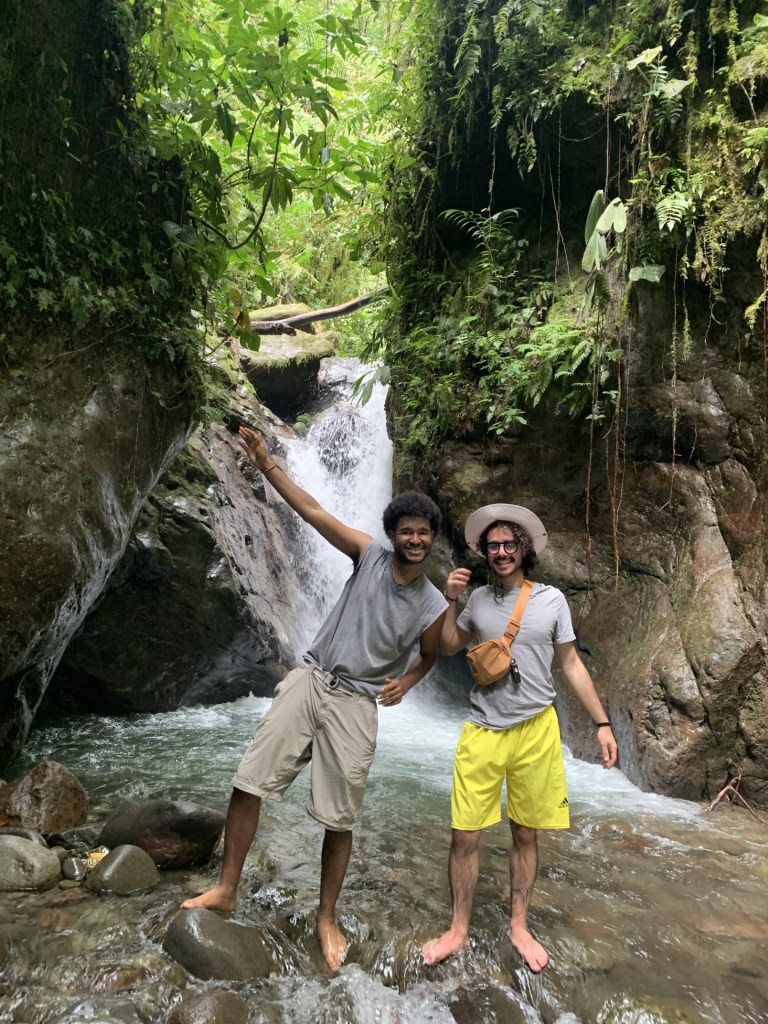
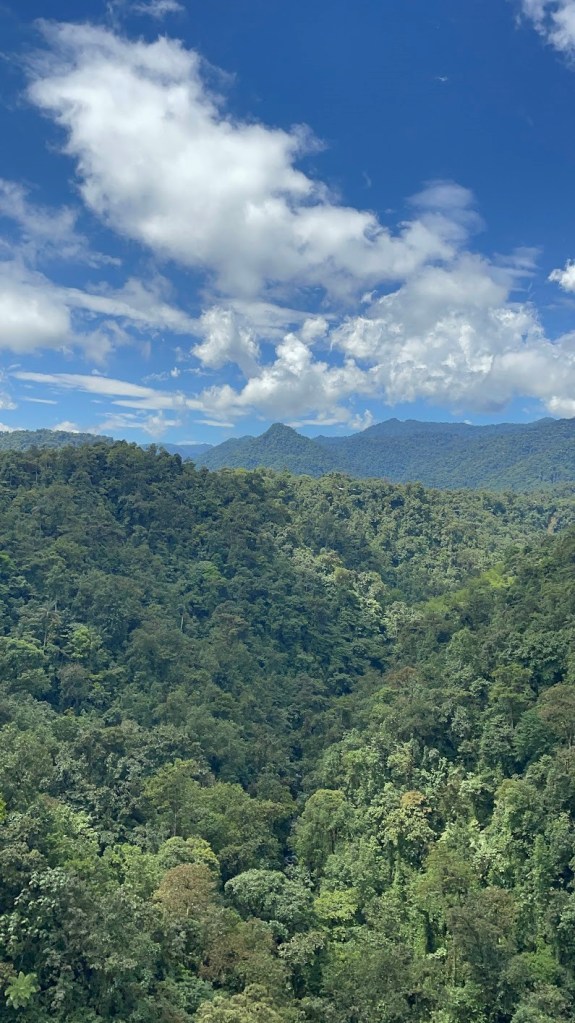
Having started our trip with this taste of all the wonder contained in Ecuador, we were excited to continue exploring. One of my close friends from undergrad also came to visit during this time, too! Together, we took a trip during our time off to a place that genuinely felt touched by a magic I’d never encountered before. We visited Mindo, a region in the Andes that straddles the Chocoan lowlands and the Tropical Andes, two of the most biologically diverse ecoregions in the world. The watershed feeds the region’s cloud forests, which is a tropical forest characterized by the low-level clouds that hug the canopy. Again, we were transported to somewhere ethereal: a place teeming with life, flowing abundantly with water, and seemingly in the sky. The hike was intense as we climbed in elevation covered in the humid forest air. But coming across a series of waterfalls that we got to cool off in made the effort worth it. We then bid Mindo farewell the next day after doing a birding hike, visiting a butterfly emporium, and an orchid garden.

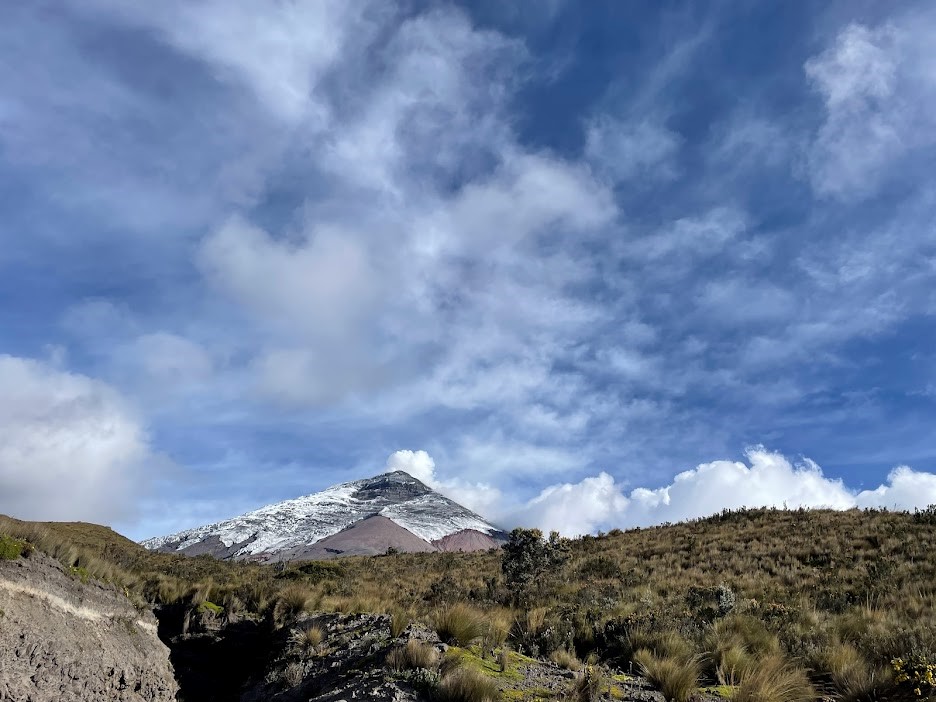
One of the high points – pun fully intended – of the trip was our climb up Cotopaxi, an active stratovolcano and the second highest summit in Ecuador at 20,000ft. Due to active eruption of the volcano during our visit, we could only climb up until the glacial line. But reaching the first base camp and climbing from there felt otherworldly. At 15,000 feet high, we traversed a lunar landscape, and among the thick cloud cover that enveloped us at that altitude, the only evidence that belied that we were anywhere still tethered to the earth were the occasional lichens and hardy plants that managed to survive the brutality of such an extreme environment. As we made our descent, the sky began to clear, and we looked back as the lunar-grey surface became the martian-red soil of the mountain and ran into the white glacial ice that crawled up to the active peak. Words fail me in capturing that moment, and when the wildflowers that sit at the base of the volcano burst into our view from the car, I felt enraptured; I felt an eutierria.


With still more to see, we planned a trip with our friends in Ecuador to visit Baños, a region thought of as a gateway to the amazon basin characterized by a downtown surrounded by lush trails, avenues of waterfalls and adventure activities. The interface of built and natural environments in the area was a really fascinating thing to see, and I loved being able to spend time with our friends in the ecological backdrop of Baños.


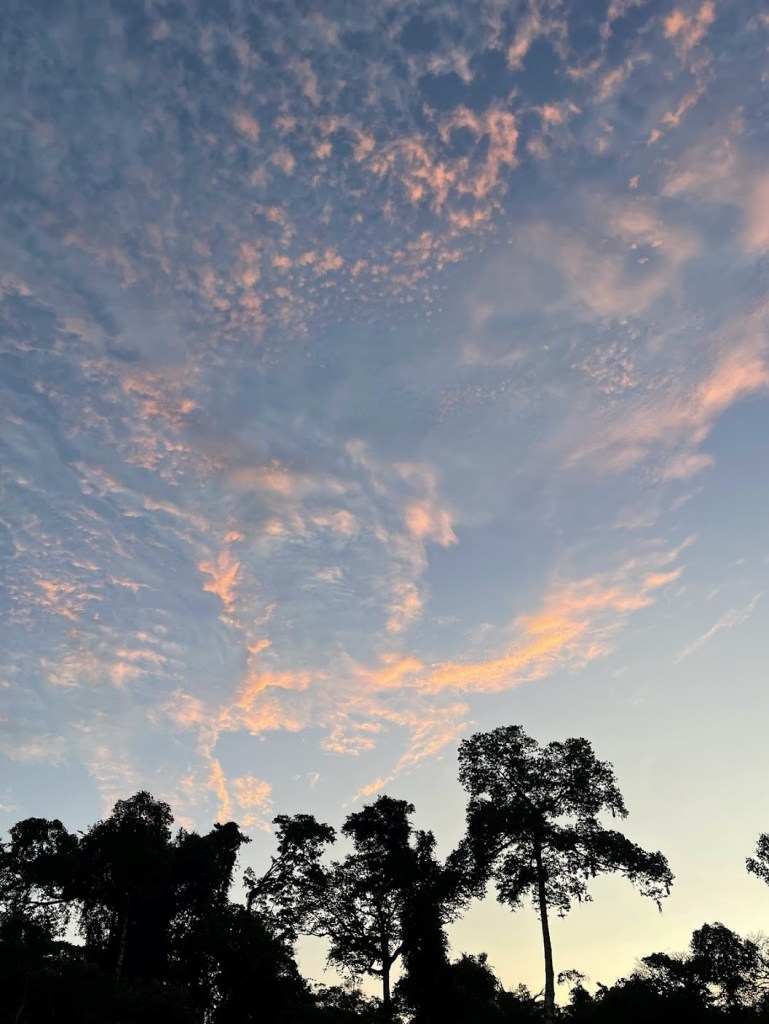
But even for all of the fascination of Baños, the most eutierria I experienced was in the Amazon Basin itself. After an overnight bus, we took a 3-hour boat ride through the rivers to reach our lodge site. The sheer joy of being in primary forest, swimming in lakes fed by the wet season, and witnessing fresh-water river dolphins escapes words. The darkness you can experience that far removed from light pollution unveils the stars in a way I had not seen them in years. One of my favorite moments was the afternoon we spent swimming in the river by our lodge, then going on a nighttime hike. The nocturnal life emerged, in its silent way, and greeted us along the path. Among them, the different spiders, of diverse forms, colors and web patterns, like quiet sentinels along the path. We walked until we came upon a 200-year-old tree – relatively young for its species – and spent a moment in silence near its sprawled, gnarled roots. I felt in those minutes we listened to the buzzing of nocturnal life and the gentle rustle of leaves, embraced, by something, by someone, by many.


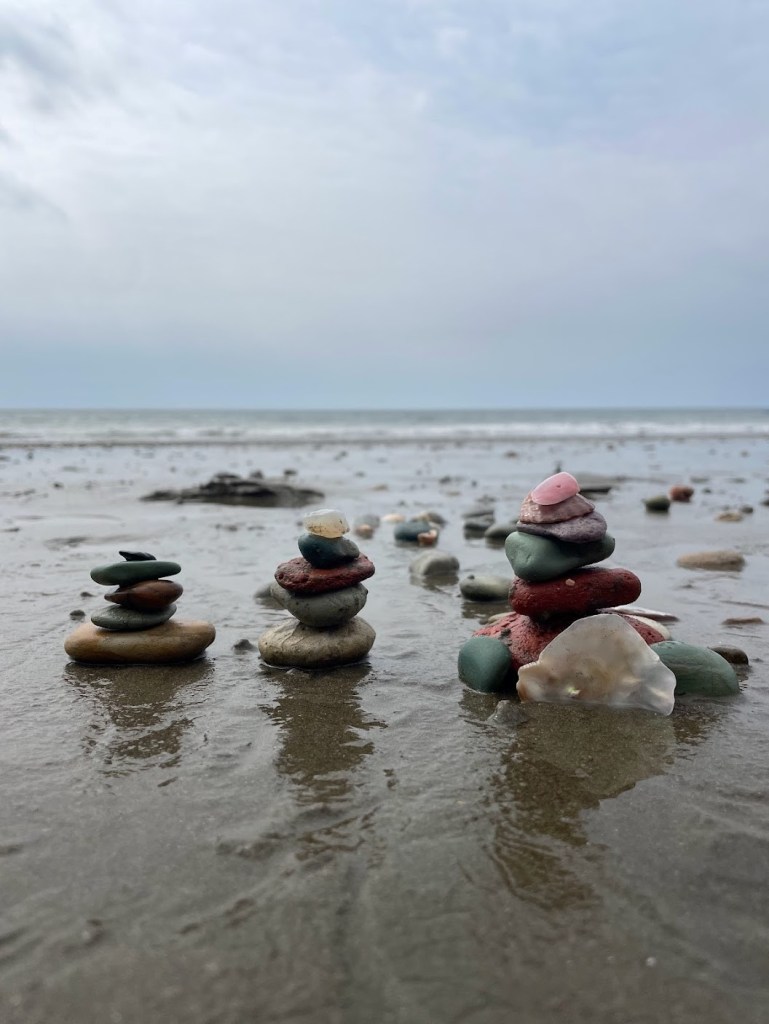
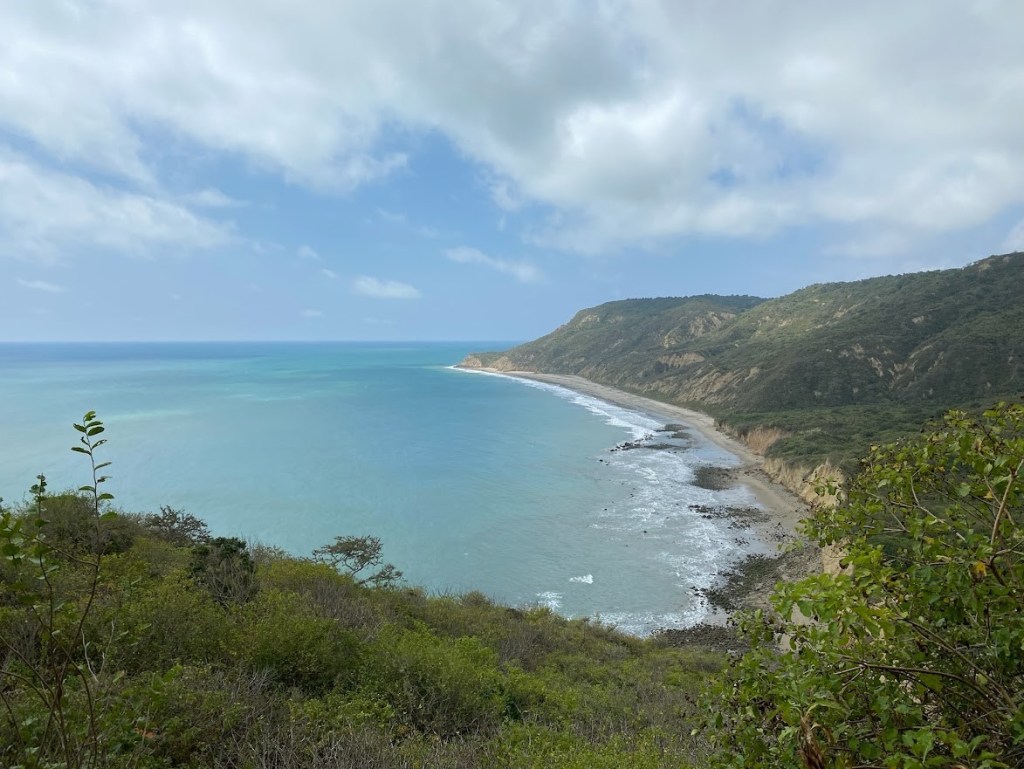
With still so much more of Ecuador’s wonder to experience, we took a trip to the coast. Along the equatorial pacific, undeveloped and uninterrupted coastlines took my breath away, and left a small pang in my heart for the ways we have disrupted coastal ecosystems in the United States. It was the last trip we were able to take outside of Quito in Ecuador, but felt like a fitting culmination of our time there. And it felt like a renewed call to action to recenter my mission to find pathways forward that are good for people and planet alike, as components of one system, as bodies that come from, and return to, the earth.