Rice, known locally as baht, is one of the most important dietary staple crops in Nepal, providing roughly 40% of total caloric intake, and contributing almost 20% to the agricultural gross domestic product. In Nepal, rice is a beloved food, and it just so happens to be my last name. As such, I quickly was given the nickname “Dr. Baht” as I started my emergency medicine rotation in Dhulikhel Hospital. It was the first of countless warm gestures made by the staff working in the emergency department (ED) that made me feel at home and marked the beginning of a memorable 4-week journey.
Nepal has always had a very special place in my heart. I first visited in 2004 when I was only 19 years old as I set my sights on climbing the Himalayan giants – the same mountains that would humble me countless times, remind me of the fragility of life and the immense power of mother nature, and challenge the conviction that makes us complacent and gives us a feeling of safety – that the world has been made for humans by humans. These natural spaces represent to me a cathedral where I draw inspiration, find time for self-reflection, and practice mindfulness. It was alone in the mountains of Nepal in my early 20s where I was gradually molded into the person I am today, and where I first fell in love with medicine.
My rotation in the emergency medicine department of Dhulikhel hospital serves as a fitting conclusion to my medical school journey. As I set my sights on moving across the country and transitioning to my residency in Emergency Medicine at George Washington University in just a few short weeks, I couldn’t have hoped for a more immersive experience. While here, I’ve treated snake bites, organophosphate poisonings, hemorrhagic strokes, high anterolateral myocardial infarctions, threatened abortions, and numerous traumatic injuries. I have been trusted to insert IVs in both adults and children (something we do only once on our first day of medical school – then never again), perform more than 20 arterial blood draws without the aid of ultrasound (including one femoral ABG!), assist with interpretation of ECGs and E-FAST exams, and assist with an intubation and manual reduction of a shoulder dislocation, all under the watchful guidance of experienced mentors.
Aside from my clinical activities, I’ve had the privilege of attending Friday resident teaching sessions and have learned innovative approaches to medical challenges (i.e. constructing a uterine balloon from a condom, a foley catheter, sterile saline, and string to stop postpartum bleeding that doesn’t respond to bimanual uterine massage and uterotonics). The ED leadership was also kind enough to allow me to participate in a two-day training on trauma and disaster team response sponsored by the United Nations and McGill University where I was able to review the ATLS protocol and triage algorithms for both adult and pediatric patients and learn from Dr. Dan Deckelbaum, the co-director of the MUHC Centre for Global Surgery. More importantly, this training was an opportunity for me to get to know more of the interns and residents I was working with, which led to them grabbing me more frequently in the ED whenever they saw an interesting case come in.
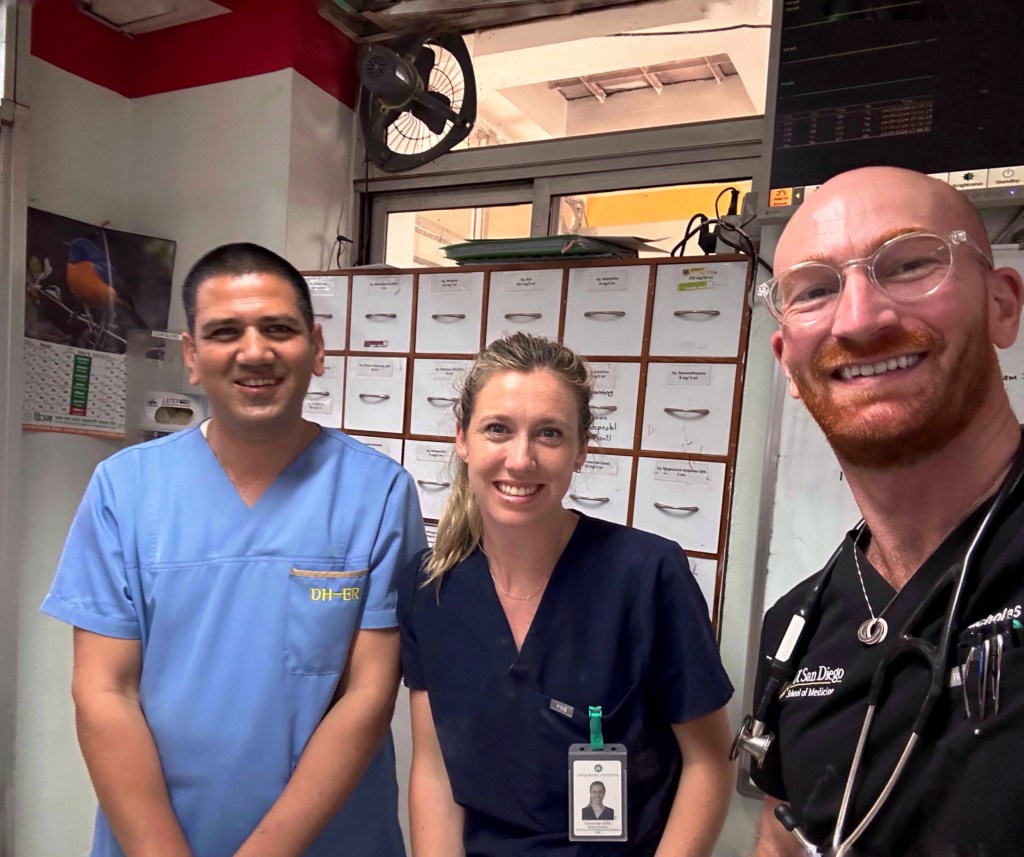
Dhulikhel Critical Care Team

DHULIKHEL EM TEAM
And as I bid farewell to Nepal, I carry with me not just memories of its breathtaking mountain landscapes but also the invaluable lessons learned within the walls of Dhulikhel Hospital and lifelong friends.

