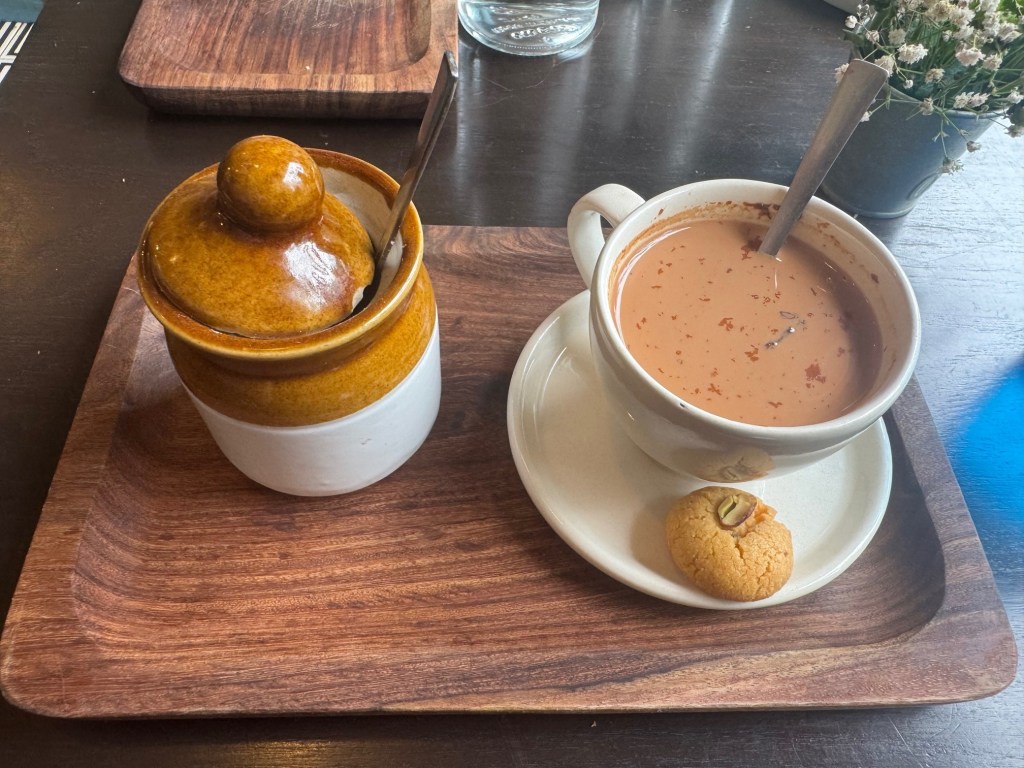
Greetings from Mumbai, India! I am writing as I sip on a masala chai inside a local café, escaping the downpour outside. As I wrap up my fifth week in Mumbai, I have come to appreciate the rains that come and go as they please. It is monsoon season here, providing a stark contrast to the blue skies of San Diego. Some days, the city receives more rain in 24 hours than San Diego averages in an entire year. But the weather hasn’t been the only new experience I’ve enjoyed during my time in Mumbai, so I wanted to use this space to recap some of those experiences and reflect on a few lessons I’ve learned along the way.
For my first year GHAC research project, I sought to learn about infectious diseases in a community different from my own, one whose challenges are not only unique but also reflect those faced by many groups around the world. Mumbai offered exactly that. Over the last five weeks, I have been working with experts in multidrug-resistant tuberculosis (MDR-TB) at Hinduja Hospital, learning through shadowing while also piloting a study using an artificial intelligence tool to analyze chest X-rays from patients with MDR-TB and compare its performance to radiologist interpretation. While I initially set out to learn whether this technology could offer benefits in a resource-limited setting, my experience has given me a much more holistic view of the challenges involved in identifying, treating, and limiting the spread of TB.
My summer began by observing diagnostic workflows for TB. Three sputum smears and three sputum cultures remain the gold standard, but molecular methods are rapidly outpacing these traditional techniques, offering much faster turnaround times when optimized. Mumbai has a particularly high burden of MDR-TB. Traditionally, patient samples must be cultured for up to six weeks to determine whether the bacteria are drug resistant. During that waiting period, it is not uncommon for patients to receive medications that ultimately prove ineffective against their particular strain of TB. Molecular methods can reduce that timeline from weeks to as little as hours or days.
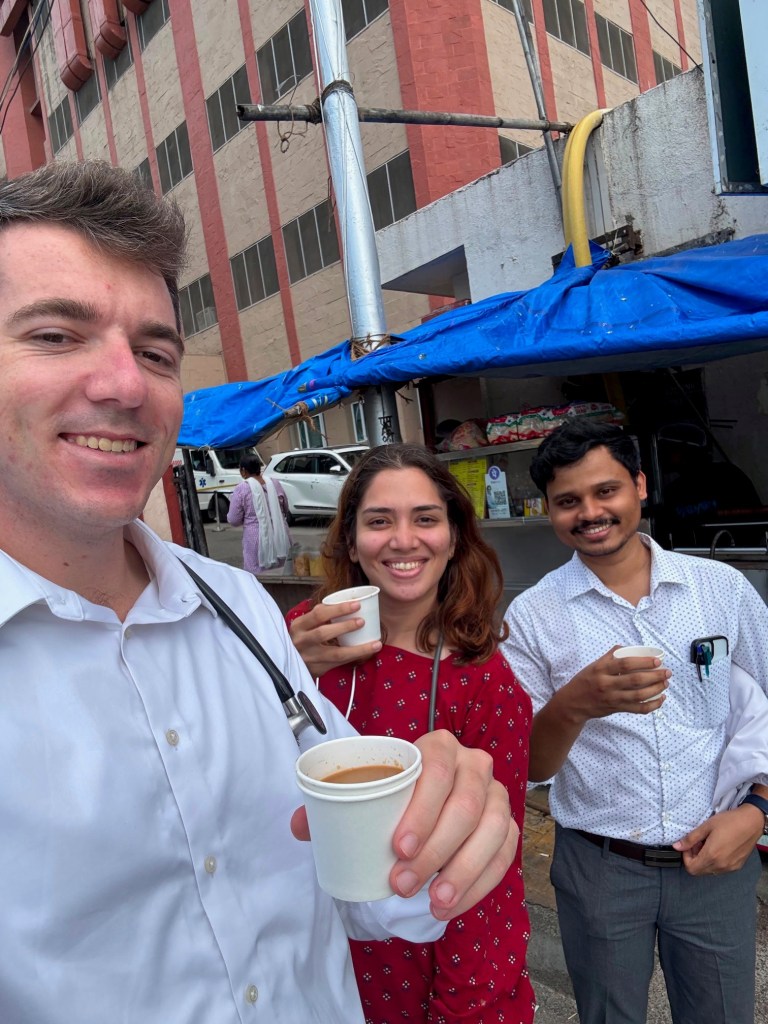
I spent my second week in Mumbai observing one of the leaders in MDR-TB surveillance, treatment, and advocacy, Dr. Zarir Udwadia, and his brilliant team of young pulmonologists. Nearly every patient visiting the clinic was asked two questions: Do you have a history of COVID-19 infection? And do you have a history of TB?
One of the insights Dr. Udwadia shared with me was that latent TB is extraordinarily common in Mumbai, and exposure to active TB is simply a fact of life that many residents must accept. Whether someone ultimately develops active disease depends on a combination of exposure and host factors. Repeated exposure through close household contacts remains the greatest risk, but conditions such as diabetes, immunocompromising illnesses, low body weight, and poor nutrition all increase the likelihood that latent infection will progress to active disease.
MDR-TB, one of the greatest public health concerns in Mumbai, is exacerbated by many factors, perhaps none more significant than adherence to the strict six month or longer treatment regimens. Patients are told to take their antibiotics every day, and their chances of recovery are high. What sounds like simple advice becomes much more complicated when the monsoons arrive.
About two weeks into my stay, just as I was starting to adjust to the scorching heat, I woke to clapping thunder. I looked out the window and watched lightning strike after lightning strike, all within a mile of where I was staying. It felt like an alarm clock sent by Mother Nature, a symbolic gesture announcing to everyone in western India that monsoon season had arrived.
As someone experiencing monsoon season for the first time, I remember thinking, Oh no… is it going to be like this every day? The hustle and bustle of a city of more than 25 million people was already challenging enough to sleep through. Was I now going to add constant thunder and lightning to the list? Fortunately, my fears, driven largely by ignorance of what monsoon season actually meant, quickly disappeared. That spectacular 30 minutes of thunder and lightning was the only time I heard thunder or saw lightning during my stay. I think I can confidently say it was simply Mother Nature’s way of announcing that the monsoons had arrived.
As days of monsoon season stacked up, sometimes bringing as much as 10 inches of rain in a single day, transportation issues throughout the city became increasingly apparent. While I may be fortunate enough to work from home on particularly difficult days, many patients do not have that luxury. Our MDR-TB patients must frequently travel to the hospital to pick up their medications. For someone whose prescription has just run out, it may not even be safe to travel on flooded roads. And if they have already been on treatment for months and are finally feeling better, could you really blame them for not wanting to march through knee-high floodwaters just to pick up another bottle of pills?
These scenarios are real and underscore one of the greatest challenges to treatment adherence. Patients often begin feeling better, and may even become symptom-free, well before completing therapy. Yet the reason these regimens are so much longer than those used for many other infectious diseases is that they dramatically reduce the chances of relapse and the development of additional antibiotic resistance.
Fast forward to now, the end of week five, and the rains have calmed down a bit. I have been able to identify, receive, and redact patient-identifying information from study participant DICOM files, the industry standard for medical imaging. I am now refining my study and working through analytic methods as it becomes clearer what data are available to our research team and which information the hospital may ultimately choose not to share.
I am fortunate that this project is truly multidisciplinary, with collaborations between my mentor at UC San Diego, Dr. Tim Rodwell; the study principal investigator from Johns Hopkins, Dr. Jeff Tornheim; the Hinduja clinical and research laboratories, including microbiologist Dr. Camilla Rodrigues; the MDR-TB outpatient clinic and research team; and the Hinduja radiology department. Coordinating among so many collaborators and requesting different pieces of data from teams in both India and the United States has certainly presented challenges. Yet these are exactly the kinds of partnerships that should be embraced if we hope to foster equitable, impactful, and globally translatable medical research.
I am deeply grateful to the mentors and collaborators mentioned above, and the UC San Diego School of Medicine Deans and GHAC for making my summer trip to Mumbai possible. I hope the work I have been fortunate enough to contribute to, and will continue after returning home, will have an impact, whether big or small, on the people of Mumbai and on communities around the world affected by TB, whether as patients, caregivers, clinicians, decision-makers, or loved ones.
As I finish this chai and watch another short burst of downpour rain roll across Mumbai, I am reminded that global health is as much about understanding people and place as it is about understanding disease. That may be the most valuable lesson this experience has taught me.